
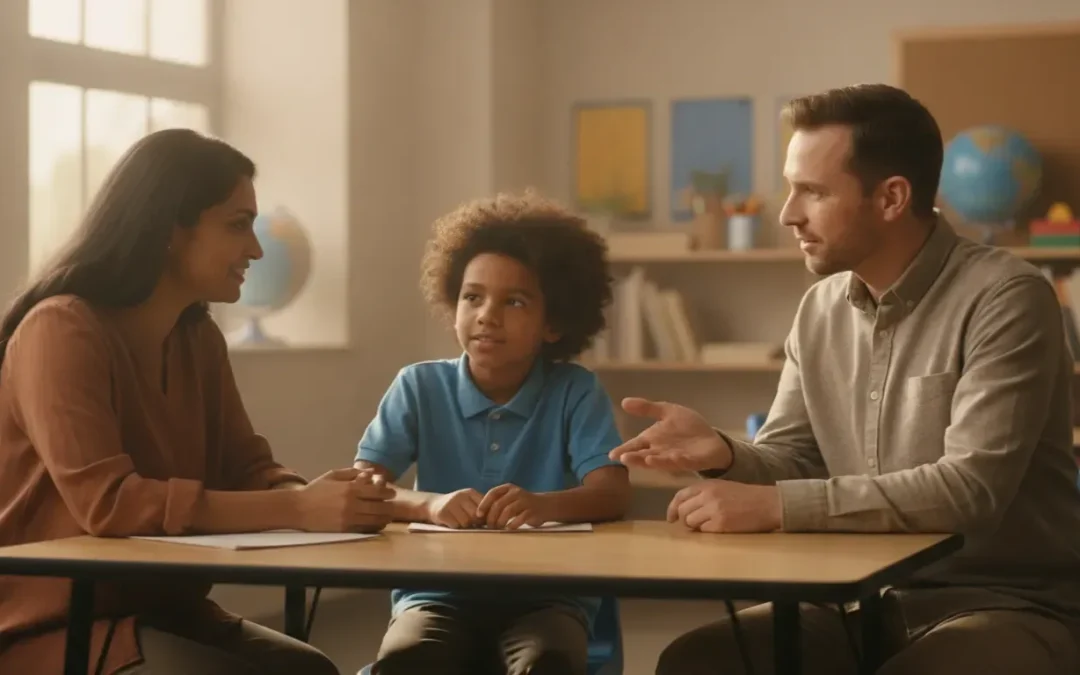
Explaining dyslexia to parents or to a child starts with a simple message: dyslexia is a difference in how a person learns written language, not a measure of intelligence, effort, or potential. With clear language, encouragement, and the right support, families can replace worry and shame with understanding and a practical plan.
Ready to explore structured literacy resources? Browse PRIDE Reading Program products.
What Does Dyslexia Mean in Everyday Language?
Dyslexia is a language-based learning difference that can make reading, spelling, and writing more difficult. The International Dyslexia Association explains that the difficulty often involves processing the sounds in spoken language and connecting those sounds to letters. Dyslexia does not mean a child is less capable, less curious, or less intelligent.
For a parent, the most useful explanation is concrete and balanced. You might say, “Your brain is working hard to connect sounds and letters. That can make reading and spelling take more effort, but it does not change how smart you are or what you can learn.” This description names the challenge without turning it into the child’s identity.
Dyslexia can look different from one learner to another. One child may read slowly, while another reads familiar words more accurately but struggles with spelling or unfamiliar words. Some children understand a story when it is read aloud but have difficulty showing that understanding on a page. A child may also develop strategies that hide the difficulty for a time.
It is also important to distinguish dyslexia from a general reading delay. A child can have difficulty reading for many reasons, including limited instruction, interrupted schooling, hearing or vision concerns, language differences, or another learning need. Reading difficulty alone cannot tell a parent what is causing the challenge. Observation, appropriate instruction, progress monitoring, and an evaluation when needed provide a more responsible path.
For a broader overview of the term, parents can read PRIDE Reading Program’s plain-language guide to what dyslexia is. The goal is not to attach a label quickly. The goal is to understand the learner and identify instruction that meets the learner’s needs.
How Can You Explain Dyslexia to a Child?
When explaining dyslexia to a child, use language that is accurate, brief, and connected to the child’s experience. A good conversation tells the child what dyslexia means, separates the difference from personal worth, and makes clear that adults will help. The child should leave feeling informed and supported, not responsible for fixing the problem alone.
Choose a calm moment rather than bringing it up during a difficult homework session. Sit beside the child, use a relaxed tone, and invite questions. You do not need to deliver every detail in one conversation. Children often understand a new explanation gradually, so return to the topic as their questions change.
A parent might say:
- “Reading is taking more effort for you because your brain is learning the sound and letter connections in a different way.”
- “Dyslexia is not caused by being lazy, and it does not mean you are not smart.”
- “We are going to find ways to practice that help your brain, and you will not have to figure it out by yourself.”
- “You can ask for extra time, a different way to practice, or help when a task feels too hard.”
Use the child’s own observations. If the child says that words seem to move, avoid confirming a misconception that dyslexia is primarily a vision problem. Instead, acknowledge the experience and say, “That sounds tiring. We can talk with your teacher about what makes reading clearer and easier to manage.” Letter reversals can occur for many early readers and are not, by themselves, proof of dyslexia.
Give the child room to disagree or feel upset. A strengths-based explanation should not force constant positivity. It can hold two truths at once: reading may be genuinely hard, and the child has abilities that are not measured by reading speed. Ask, “What part of reading feels hardest right now?” and “What helps you feel more confident?”
What Reading and Spelling Challenges Might a Child Experience?
Children with dyslexia may have persistent difficulty with accurate or fluent word recognition, decoding, spelling, and the sound structure of language. The pattern is more informative than one isolated mistake. Parents can watch for repeated effort across settings while remembering that these observations are a reason to seek support, not a basis for diagnosing a child at home.
Common experiences may include:
- Difficulty recognizing or producing rhymes and separating words into sounds.
- Uncertainty when matching a letter or letter pattern to its sound.
- Slow, effortful reading, especially with unfamiliar words.
- Guessing from pictures or the first letter instead of reading through a word.
- Inconsistent spelling of the same word from one attempt to the next.
- Difficulty remembering common spelling patterns, sequences, or sound-symbol relationships.
- Fatigue, avoidance, frustration, or worry around reading and writing tasks.
These challenges do not describe every learner, and they do not predict a child’s future. A child may have strong listening comprehension, vocabulary, reasoning, humor, spatial thinking, creativity, or curiosity while still needing explicit reading instruction. Do not use a strengths-based message to minimize the work reading requires. Use it to give the child a complete and respectful picture.
Parents who want a detailed discussion of signs and evaluation should use a dedicated resource such as PRIDE’s guide to dyslexia signs, testing, and next steps. This article has a different purpose: helping families talk about what they are seeing without turning a list of behaviors into a conclusion.
What Strengths Should Parents Recognize?
Recognizing strengths means seeing the whole learner, not creating a new stereotype. A child with dyslexia may show creativity, persistence, empathy, strong oral language, problem-solving, visual thinking, or deep interest in a subject. Strengths vary by individual, so ask what this child enjoys and does well rather than assuming every child shares the same profile.
Reading ability and intelligence are not the same thing. A child may need direct teaching for decoding while already understanding complex ideas through conversation, discussion, experiments, or audiobooks. Offer access to rich content in formats that do not make decoding the gatekeeper for learning. At the same time, continue building reading skills through instruction matched to the child’s needs.
Be specific with praise. Instead of saying only, “You are so smart,” try, “You stayed with that word and checked each sound,” or, “You explained your idea clearly and found another way to solve the problem.” Specific feedback helps a child recognize useful actions, not just a fixed trait that may feel threatened by a hard assignment.
Parents can also help protect identity outside school. Make room for activities where the child feels capable, such as music, art, building, sports, cooking, nature, coding, storytelling, or caring for animals. These activities do not replace reading instruction. They remind the child that reading is one skill being developed, not the boundary of who they are.
What Should Parents Ask During an Evaluation or School Conversation?
A parent does not need to arrive at a school meeting with a diagnosis or a perfect explanation. The most productive questions connect the child’s observed needs to instruction, progress, and follow-up. Ask for specific examples, clarify what has already been tried, and request a way to review whether the support is helping.
Useful questions include:
- Which reading and spelling skills are currently strong, and which skills require the most support?
- What do you notice about the child’s decoding, phonological awareness, spelling, fluency, and comprehension?
- What instruction has been provided, for how long, and how consistently?
- How will progress be measured, and how often will we review the information?
- What will instruction look like during a typical week?
- How can home practice reinforce school instruction without becoming a source of conflict?
- What accommodations or access supports could help the child participate while skills are developing?
- When should we meet again to adjust the plan if progress is limited?
Ask for plain-language explanations of test results and educational terms. If the school suggests an evaluation, ask who will complete it, which skills will be considered, and how the results will inform instruction. A school conversation and a formal evaluation are not the same thing. Families can seek guidance from qualified professionals when the child’s needs are unclear or when progress remains limited despite appropriate support.
Keep a short observation record at home. Note the task, what the child did, the amount of help needed, and what made the task easier or harder. Avoid turning practice into a test. The record is useful because it shows patterns over time and gives teachers concrete information to discuss.
How Can Home and School Work Together?
Home and school support works best when adults use compatible language, routines, and expectations. The purpose of home practice is not to recreate a full classroom lesson or make a parent act as a diagnostician. It is to provide brief, calm opportunities to apply taught skills, read meaningful text, and build confidence through achievable practice.
At home, consider these practical steps:
- Set a predictable practice time and keep sessions short enough to end successfully.
- Ask the teacher which sound-spelling pattern or word-reading skill to reinforce.
- Have the child look at the word, say the sounds, blend them, and check the result instead of guessing.
- Use a finger, card, or other simple tool to support attention without making the activity feel childish.
- Read aloud to the child and discuss interesting ideas so access to language stays broad.
- Stop before frustration becomes the main lesson, then record what happened for the next conversation.
Choose decodable practice that matches the patterns the child has been taught. A child should not be expected to independently read text full of patterns that have not been introduced. If a book is too difficult for independent reading, an adult can read it aloud while the child follows the ideas and enjoys the story.
For more home-based ideas, see PRIDE’s strategies for helping a child with dyslexia at home. Keep the focus on consistency and connection. A calm five-minute practice that the child can repeat is often more useful than a long session that ends in tears.
How Can Structured Literacy Support a Learner?
Structured literacy teaches reading and spelling in an explicit, systematic, cumulative, and connected way. Lessons make the relationships among sounds, letters, syllables, word parts, reading, and spelling visible. A multisensory routine may ask a learner to look, say, listen, write, or use movement while practicing a concept. The approach is instruction, not a promise of instant results.
The Orton-Gillingham approach is one structured literacy influence used by programs for learners who need direct, carefully sequenced teaching. PRIDE Reading Program builds its curriculum around an Orton-Gillingham approach with scripted lessons and multisensory practice. Families considering any program should ask how skills are sequenced, how lessons respond to errors, how practice is reviewed, and how progress is monitored.
Structured literacy does not mean that every child needs the same lesson or that a parent must use specialized terminology. It means the instruction is planned rather than based on guessing, memorizing disconnected lists, or moving ahead before a foundational skill is secure. Parents can learn more in PRIDE’s overview of structured literacy for dyslexia.
When discussing Orton-Gillingham instruction, use measured language. It may support learners by giving them explicit practice with the sound and structure of language, but no method can guarantee the same outcome for every child. Progress depends on the learner, the instruction, the consistency of practice, and the broader support plan.
Ready to choose your next reading step? Browse PRIDE Reading Program products.
Frequently Asked Questions
How do you explain dyslexia to parents in simple terms?
Explain that dyslexia is a language-based learning difference that can make reading and spelling more difficult, especially when a learner is connecting speech sounds with letters. Emphasize that it is not caused by laziness or low intelligence. Then describe the specific support the child needs and the next step for learning more.
How should a parent explain dyslexia to a child?
Use calm, direct language: “Your brain learns some reading skills differently, so reading may take more effort. This is not your fault, and it does not define how smart you are. We will find instruction and tools that help.” Invite questions and revisit the conversation over time.
Is dyslexia the same as a general reading difficulty?
No. Dyslexia is one possible explanation for persistent difficulty with reading and spelling, but a reading challenge can have many causes. A child may need better instruction, additional practice, or support for another learning need. Families should use qualified evaluation and progress information rather than trying to determine the cause from one symptom.
What should parents do first if they are concerned?
Write down the reading and spelling patterns you are noticing, ask the child’s teacher for specific observations, and discuss what instruction has already been provided. Ask how progress will be measured and when the team will review it. Keep reading aloud and supporting the child’s interests while the next steps are clarified.
Can Orton-Gillingham instruction help a child with dyslexia?
An explicit, systematic, multisensory Orton-Gillingham approach may support a learner who needs direct teaching of sound, letter, word, and spelling relationships. Families should ask how the program sequences skills, provides practice, and monitors progress. It is important to avoid promises of guaranteed results and choose support that fits the learner.
How can parents protect a child’s confidence?
Separate the reading task from the child’s identity, give specific praise for useful effort and strategy, provide access to rich ideas through read-alouds and audio when appropriate, and make time for activities the child enjoys. Confidence grows when adults provide effective instruction while continuing to see and value the whole learner.