
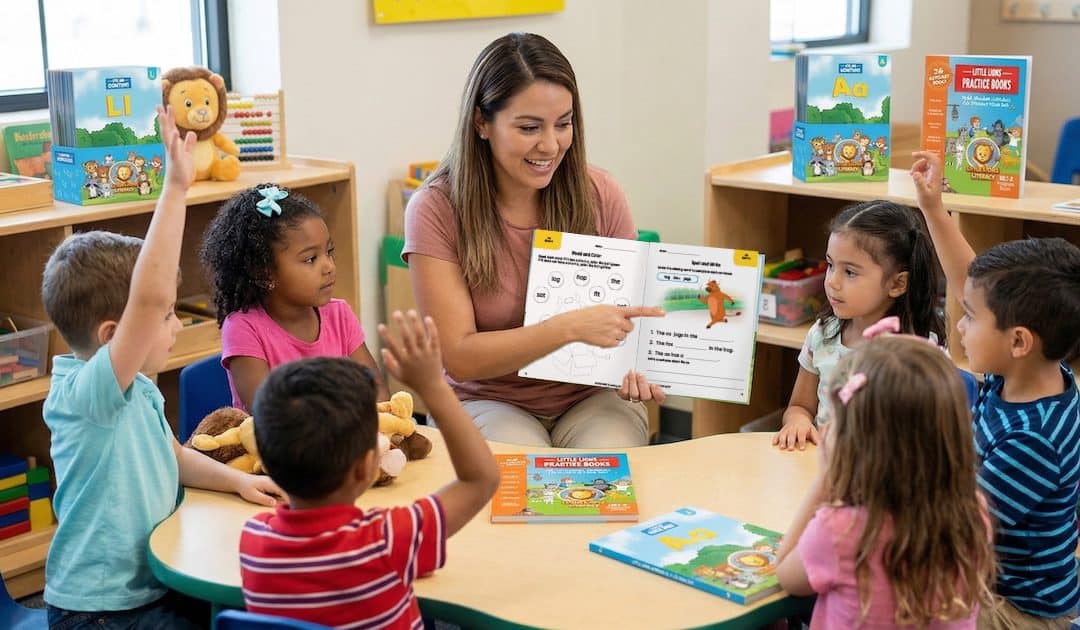
For decades, reading instruction in American schools relied on methods that asked children to guess at words using pictures and context clues. The results were predictable: according to the National Assessment of Educational Progress (NAEP), only 33% of fourth graders in the United States read at or above a proficient level. That number has barely moved in 30 years. Now, a growing body of cognitive science research is pushing schools to rethink everything about how they teach children to read. More than 40 states have passed legislation requiring schools to adopt instructional practices grounded in the Science of Reading, and school districts everywhere are working to put that research into daily classroom practice.
Explore phonics programs designed for school-wide Science of Reading implementation.
What Is the Science of Reading?
The Science of Reading is not a curriculum or a program. It is a body of research spanning more than five decades of work in cognitive psychology, linguistics, and neuroscience that explains how the brain learns to read. This research consistently shows that reading is not a natural process like learning to speak. It must be taught directly and systematically.
At the center of this research are five pillars that effective reading instruction must address:
- Phonemic awareness: The ability to hear, identify, and manipulate individual sounds in spoken words.
- Phonics: Understanding the relationship between letters and the sounds they represent, and using that knowledge to decode words.
- Fluency: Reading text accurately, at an appropriate speed, and with proper expression.
- Vocabulary: Knowing and understanding the meaning of words encountered in text.
- Comprehension: The ability to understand, remember, and make meaning from what is read.
When schools implement the Science of Reading, they are building instructional systems that address all five of these pillars through explicit, systematic teaching rather than leaving any of them to chance. This stands in direct contrast to earlier approaches like Balanced Literacy or Whole Language, which often encouraged students to guess at unfamiliar words instead of sounding them out.

Why More Than 40 States Now Require Science of Reading Instruction
The push toward Science of Reading implementation in schools did not happen overnight. It began with Mississippi. In 2013, the state passed the Literacy-Based Promotion Act, which required schools to use evidence-based reading practices and held back third graders who could not read at grade level. Within a few years, Mississippi went from ranking near the bottom in national reading scores to becoming the only state showing significant gains on the NAEP.
Mississippi’s success caught the attention of lawmakers and educators across the country. Since then, more than 40 states have enacted some form of Science of Reading legislation. These laws vary in scope but generally require one or more of the following:
- Adoption of curricula aligned with structured literacy principles
- Mandatory teacher training in evidence-based reading instruction
- Universal screening for reading difficulties in early grades
- Elimination of the “three-cueing” system (using pictures, context, and first letters to guess words)
States like Texas created Reading Academies that require every K-3 teacher and principal to complete extensive training. Ohio passed the “Right to Read” act mandating that districts use only approved, evidence-based curricula. Colorado, North Carolina, and Virginia have all passed similar laws with their own implementation timelines and requirements.
This legislative momentum reflects a growing consensus: the research is clear, and schools must act on it.
What Science of Reading Implementation Looks Like in the Classroom
Legislation sets the direction, but the real work happens inside classrooms. When a school successfully implements the Science of Reading, several things change in how teachers deliver daily reading instruction.
Structured Phonics Blocks
Teachers dedicate specific time each day to explicit phonics instruction. Lessons follow a carefully sequenced scope and sequence, starting with the simplest letter-sound relationships and building toward more complex patterns like vowel teams, r-controlled vowels, and multisyllable words. Every concept is taught directly. Students never have to figure out a pattern on their own.
Decodable Readers Replace Leveled Books
In many classrooms, the shift away from leveled readers is one of the most visible changes. Leveled books often contain words students have not been taught to decode, encouraging guessing. Structured literacy classrooms use decodable books instead. These texts are written using only the phonics patterns students have already learned, allowing children to practice real reading rather than memorizing or guessing.
Explicit Vocabulary and Comprehension Instruction
Science of Reading implementation goes beyond phonics. Teachers build vocabulary through direct instruction of word meanings, morphology (prefixes, suffixes, and root words), and rich read-aloud sessions. Comprehension instruction involves teaching students specific strategies for understanding text: making predictions, summarizing, identifying main ideas, and connecting new information to prior knowledge.
Multisensory Teaching Methods
Many schools adopting the Science of Reading also incorporate Orton-Gillingham-based methods that engage multiple senses during instruction. Students might trace letters in sand while saying the sound, tap out syllables, or use letter tiles to build and manipulate words. These techniques create stronger neural pathways and are especially effective for students with dyslexia and other reading difficulties.
Five Things Every School Needs for Successful Implementation
Passing a law or purchasing a new curriculum does not automatically improve reading instruction. Schools that see real results share several common elements in their approach to implementation.
1. A high-quality, evidence-based curriculum. The foundation of any implementation effort is the instructional material itself. Schools need a curriculum aligned with Science of Reading principles that provides explicit, systematic instruction in phonics, vocabulary, fluency, and comprehension. Programs with fully scripted lessons are especially valuable because they reduce the burden on teachers while maintaining instructional consistency across classrooms.
2. Teacher training and ongoing professional development. A curriculum is only as effective as the person teaching it. Teachers need professional development in the Science of Reading that goes beyond a single workshop. Effective training helps teachers understand the research behind the methods, practice delivering lessons, and learn how to adapt instruction for students who need additional support.
3. Universal screening and assessment systems. Schools need tools to identify struggling readers early. Universal screening in kindergarten through third grade allows teachers to catch reading difficulties before they become entrenched. Progress monitoring throughout the year helps teachers adjust instruction and provide targeted intervention to students who are falling behind.
4. Leadership buy-in from administrators. Implementation fails when it is treated as a teacher-level initiative without support from school and district leaders. Principals and curriculum directors need to understand the Science of Reading, allocate budget for materials and training, protect instructional time, and hold the school accountable for using evidence-based practices consistently.
5. A realistic timeline and implementation plan. Changing how an entire school teaches reading takes time. Rushing the process leads to confusion, burnout, and half-hearted adoption. Successful districts typically plan for a three- to five-year implementation window that includes phased curriculum rollout, multiple rounds of teacher training, and regular check-ins to assess progress and solve problems.
See how PRIDE Reading Program supports school-wide structured literacy implementation.
Common Challenges Schools Face During Implementation
Even with strong legislation and good intentions, Science of Reading implementation is not easy. Schools across the country are encountering similar obstacles, and understanding these challenges is the first step toward overcoming them.
Resistance to Changing Established Practices
Many experienced teachers have spent years using Balanced Literacy or Whole Language methods. Being told that those approaches are not supported by research can feel like a personal criticism. Effective implementation requires sensitivity to this dynamic. Schools that succeed frame the transition as professional growth rather than an indictment of past practice.
The Cost of New Curricula and Materials
Replacing an entire literacy curriculum is expensive. District-level adoptions can cost hundreds of thousands of dollars when you factor in student materials, teacher guides, decodable readers, and assessment tools. Federal and state funding sources like Title I and IDEA grants can help offset these costs, but securing and allocating that funding requires planning and advocacy.
Insufficient or Inconsistent Training
A single professional development session is not enough to change how a teacher teaches reading. Yet many districts provide only minimal training before expecting teachers to implement a new curriculum. Schools need sustained, job-embedded coaching where literacy specialists work alongside teachers in their classrooms, model lessons, and provide real-time feedback.
Maintaining Fidelity Over Time
The initial enthusiasm of a new initiative can fade quickly. Without ongoing support and accountability, teachers may drift back to familiar habits or begin skipping parts of the curriculum they find challenging or time-consuming. Regular walkthroughs, peer observations, and data reviews help schools maintain fidelity to the instructional model.
How Parents Can Tell If Their Child’s School Uses the Science of Reading
Parents play an important role in supporting reading instruction, but it can be hard to know whether a school is using evidence-based methods. Here are some questions parents can ask and signs to look for.
Questions to ask your child’s teacher or principal:
- “What reading curriculum does the school use, and is it aligned with the Science of Reading?”
- “Does my child receive explicit phonics instruction every day?”
- “How do you screen students for reading difficulties, and when does intervention begin?”
- “Are teachers trained in structured literacy methods?”
Signs that a school is on the right track:
- Your child brings home decodable books that match what they are learning in phonics lessons.
- Homework and classwork include activities focused on letter sounds, blending, and spelling patterns rather than memorizing whole words.
- The school screens all students for reading skills at least twice a year.
- Teachers can explain the specific phonics concepts your child is working on.
Red flags that suggest outdated methods:
- Your child is encouraged to look at pictures to figure out unknown words.
- The school uses leveled readers as the primary reading material without phonics instruction.
- There is no formal screening process for identifying struggling readers.
How Structured Literacy Tutoring Supports Science of Reading Goals
Classroom instruction is the first line of support, but some students need additional help. Research consistently shows that approximately 5% to 15% of students require intensive, individualized intervention beyond what classroom instruction alone can provide. This is where structured literacy interventions become essential.
Structured literacy tutoring programs use the same research-based principles found in Science of Reading classrooms but deliver them in a one-on-one or small-group setting where instruction can be tailored to each student’s specific needs. Programs based on the Orton-Gillingham approach are especially effective because they are diagnostic and prescriptive: the instructor assesses exactly where a student’s skills break down and builds lessons from that point.
For parents whose children are struggling despite receiving Science of Reading instruction at school, outside tutoring with a trained specialist can fill gaps and accelerate progress. The key is finding a program that uses the same explicit, systematic methods the classroom uses, not one that relies on repetition, memorization, or technology-based shortcuts.
Compare the best structured literacy reading programs for elementary students.
What to Do If Your Child Is Still Struggling with Reading
Even in schools that have fully adopted the Science of Reading, some children will need more support. Reading difficulties like dyslexia affect an estimated 15% to 20% of the population, and early identification is critical. If your child is struggling, here are practical steps you can take.
1. Request a reading evaluation. Ask your child’s school for a formal evaluation of their reading skills. Under federal law (IDEA), schools are required to evaluate children suspected of having a learning disability at no cost to families.
2. Look for specific signs of reading difficulty. Does your child have trouble sounding out unfamiliar words? Do they confuse similar-looking letters like b and d? Do they avoid reading or become frustrated quickly? These patterns may indicate dyslexia or another reading-related learning difference.
3. Ask about intervention services. Many schools offer tiered intervention programs (often called RTI or MTSS) that provide additional reading instruction to students who are behind. Ask what level of support your child is receiving and whether the intervention uses structured literacy components.
4. Consider a structured literacy tutoring program. If school-based intervention is not enough, working with a trained structured literacy specialist outside of school can make a significant difference. Look for programs that are Orton-Gillingham-based, fully scripted for consistency, and designed to show measurable progress within weeks.
5. Stay involved and informed. Attend parent-teacher conferences, review progress reports, and keep open communication with your child’s teachers. The more you understand about what your child is learning and where they are struggling, the better you can advocate for the support they need.
Frequently Asked Questions
What is the Science of Reading?
The Science of Reading is a body of research from cognitive science, psychology, and linguistics that explains how the brain learns to read. It shows that reading must be taught explicitly and systematically, covering phonemic awareness, phonics, fluency, vocabulary, and comprehension. More than 40 states have passed laws requiring schools to use instructional methods based on this research.
How many states have Science of Reading laws?
As of 2026, more than 40 states have enacted some form of Science of Reading legislation. These laws typically require evidence-based reading curricula, mandatory teacher training, universal screening for reading difficulties, and the elimination of instructional methods that encourage word-guessing.
What is the difference between the Science of Reading and Balanced Literacy?
The Science of Reading emphasizes explicit, systematic phonics instruction where students learn to decode words by understanding letter-sound relationships. Balanced Literacy, by contrast, often includes a “three-cueing” system that encourages children to guess words based on context, pictures, or first letters. Research shows that explicit phonics instruction produces stronger reading outcomes, especially for struggling readers.
How long does it take a school to implement the Science of Reading?
Most districts plan for a three- to five-year implementation period. This includes selecting an evidence-based structured literacy curriculum, training all teachers, establishing screening and assessment systems, and building a culture of ongoing support and accountability.
What should parents do if their child’s school is not using the Science of Reading?
Start by asking your child’s teacher and principal about the reading curriculum and whether it aligns with Science of Reading research. If the school is not yet using evidence-based methods, you can advocate for change at school board meetings, connect with parent organizations focused on reading reform, and supplement your child’s instruction at home with a structured literacy program.
Moving Forward with Science of Reading Implementation
The shift toward Science of Reading instruction represents one of the most significant changes in American education in a generation. After decades of stagnant reading scores and mounting evidence that earlier methods were not working for millions of children, schools are finally adopting practices that align with how the brain actually learns to read.
This transition is not simple. It requires new curricula, extensive teacher training, strong leadership, and sustained effort over years. But the schools and districts that commit to this work are seeing real results: more children reading at grade level, fewer students needing intensive intervention, and a more equitable system where every child has access to instruction that works.
Whether you are a school administrator planning an implementation, a teacher adapting your instruction, or a parent looking for the right support for your child, the path forward starts with the same question: Is the reading instruction grounded in research? If it is, every other piece falls into place.
Learn how PRIDE Reading Program can support your school’s Science of Reading goals.